
Burj Khalifa vs Jeddah Tower: Comparing the World’s Tallest Buildings

Two structures define the upper limits of human construction capability: Burj Khalifa in Dubai, which has held the title of world’s tallest building since 2010, and Jeddah Tower in Saudi Arabia, currently under construction to surpass it. Both towers share the same lead architect, employ similar structural philosophies, and push engineering boundaries in comparable desert environments—yet their differences reveal how supertall building design has evolved over the past 15 years.
Burj Khalifa is the tallest completed building in the world at 828 meters, while Jeddah Tower is designed to exceed 1,000 meters but remains under construction.
This comparison examines the technical, economic, and architectural distinctions between these mega tall structures, explaining why certain design decisions were made and what each tower represents in the context of regional development and global engineering achievement.
Burj Khalifa Vs Jeddah Tower Height: The Defining Measurement
Height functions as more than a headline figure in supertall buildings; it determines how floors are classified, where public access is feasible, and how structural loads are distributed vertically. In the case of Burj Khalifa, height directly shapes the placement of observation decks and defines the limits of publicly accessible space within the tower.
Burj Khalifa height and public levels
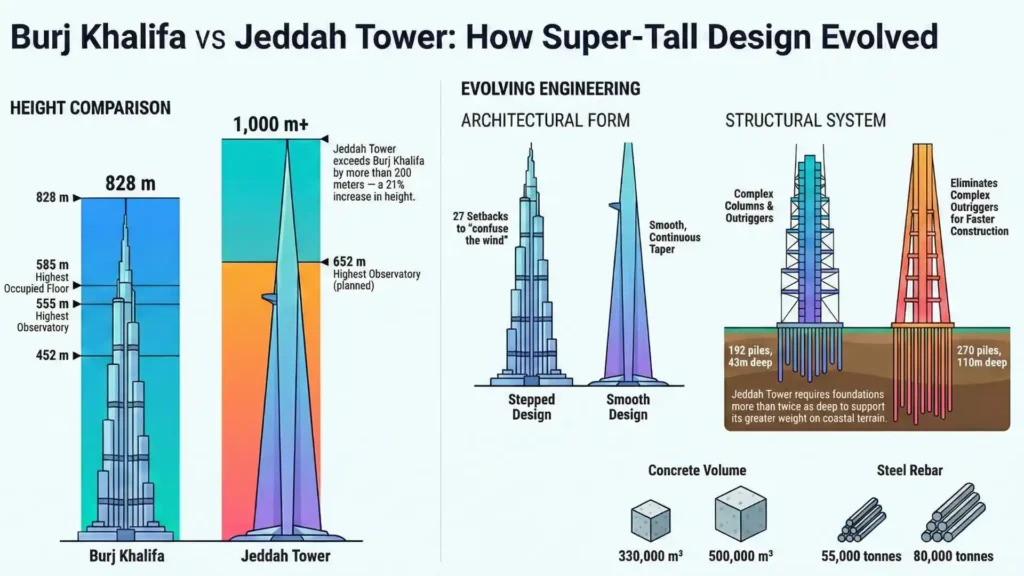
Burj Khalifa stands at 828 meters (2,717 feet) to its architectural top, with 829.8 meters including the spire. The tower comprises 163 floors above ground, with the highest occupied floor at 585.4 meters. Its observation decks reach 452 meters (Level 124), 555 meters (Level 148), and the highest public space at 585 meters (The Lounge on floors 152-154).
Jeddah Tower target height and planned observatory
Jeddah Tower is designed to reach at least 1,000 meters (3,281 feet)—though the exact final height remains officially undisclosed, following the same secrecy strategy used during Burj Khalifa’s construction. The tower will contain approximately 167 floors, with the observation deck positioned at 652 meters on the 157th floor, making it 100 meters higher than Burj Khalifa’s highest public viewing area.
| Feature | Burj Khalifa | Jeddah Tower |
|---|---|---|
| Location | Dubai, United Arab Emirates | Jeddah, Saudi Arabia |
| Status | Completed (2010) | Under construction (completion target: 2028) |
| Architectural Height | 828 m (2,717 ft) | 1,000 m+ (exact height undisclosed) |
| Floors | 163 | ~167 |
| Highest Occupied Floor | 585.4 m | Planned above 600 m |
| Highest Public Level | 585 m (Levels 152–154, The Lounge) | 652 m (Level 157 observatory) |
| Architect | Adrian Smith (SOM) | Adrian Smith + Gordon Gill Architecture |
| Structural System | Buttressed core with setbacks | Tapered reinforced concrete wall system |
Why the extra 200 meters changes everything
The height difference matters beyond symbolism. At one kilometer, Jeddah Tower will be the first human-made structure to break the psychological thousand-meter threshold. This represents approximately 21% more height than Burj Khalifa—a substantial engineering challenge given that structural problems scale non-linearly with height. Wind forces, elevator technology, concrete pumping, vertical transportation, and foundation requirements all become exponentially more complex beyond 800 meters.
Architectural Design Philosophy
Both towers employ Adrian Smith as the primary architect, creating a unique opportunity to observe how one designer’s approach evolved between projects separated by nearly two decades of development.
Burj Khalifa Architectural Approach
Burj Khalifa Features a stepped, spiraling form inspired by the Hymenocallis flower (spider lily) common to the Middle East. The Y-shaped floor plan steps back 27 times as it rises, creating distinct tiers that progressively reduce the tower’s cross-sectional area. Each setback aligns with the structural grid, allowing columns above to align with walls below, providing smooth load transfer without the construction delays typically caused by column transfers.
This setback strategy serves a critical aerodynamic function: it “confuses the wind.” As air flows around the building, vortex shedding patterns cannot organize because each tier presents a different building shape to the wind. This prevents the synchronized vortex formation that causes excessive lateral movement in tall structures. The design process involved extensive wind tunnel testing at RWDI’s facility in Canada, where scale models demonstrated how the spiral setbacks disrupted wind flow patterns.
Jeddah Tower Architectural Approach
Jeddah Tower employs a continuously tapering profile without discrete setbacks. The Y-shaped footprint remains consistent, but the plan gradually reduces in size from base to top in a smooth, needle-like form. This represents a structural simplification compared to Burj Khalifa’s approach.
The aerodynamic principle remains similar—disrupting organized wind patterns—but the execution differs. Rather than stepping back at specific intervals, Jeddah Tower’s continuous taper means wind encounters constantly changing building dimensions, achieving vortex disruption through gradual rather than sudden geometry changes. Wind tunnel testing confirmed that this approach effectively manages wind-induced accelerations while allowing simpler construction sequencing.
The visual result is striking: Burj Khalifa appears as a faceted, crystalline tower that catches and reflects light differently at each tier. Jeddah Tower will present as a sleek, monolithic spire rising from the desert without horizontal breaks. Both designs reference regional influences—Burj Khalifa through Islamic architectural motifs and spiral minarets, Jeddah Tower through the form of a sprouting desert plant’s folded fronds.
Structural Engineering Systems
The structural systems reveal how engineering methodology progressed between 2004 and 2013.
Burj Khalifa structural system (buttressed core)
Burj Khalifa uses what its engineers call a “buttressed core” system. The central hexagonal core houses all vertical transportation (elevators and mechanical systems) except emergency egress stairs, which are located within each wing. Each of the three wings has its own high-performance concrete core walls and perimeter columns. These wings buttress each other through the six-sided central hub, creating a structure with exceptional torsional resistance.
The system functions like three separate buildings supporting each other through a common core. This provides redundancy—if one wing experiences damage, the other two continue supporting the structure. The configuration also optimizes interior space usage, as the triangular geometry provides maximum usable floor area with superior views.
Construction employed a jump-form system up to level 156, where the concrete structure transitions to structural steel for the uppermost floors and spire. The final 243-meter spire, weighing 350 tons, was assembled in sections within the tower, then hydraulically jacked into position over eight separate lift cycles—a technique reminiscent of the Chrysler Building’s spire installation in 1929 but at vastly larger scale.
Jeddah Tower structural system (tapered wall system)
Jeddah Tower simplifies this structural approach. The system consists of a tapered, triangular reinforced concrete tube with double-layered wing walls at the three corners. Additional lateral walls brace the wing walls and serve as vertical supports for flat slabs.
Critically, the design eliminates columns, floor beams, spandrel beams, outrigger systems, and vertical transfers. Every structural element consists of walls and slabs that can be constructed using climbing formwork or conventional slab formwork. This represents a fundamental shift toward construction efficiency—the simpler the structural system, the faster and more reliably it can be built.
All walls interconnect, and each structural element resists both wind and gravity loads simultaneously. This differs from conventional supertall design where different systems handle different load types (outriggers for wind, columns for gravity). The unified approach reduces complexity but requires careful analysis to ensure adequate performance under all loading conditions.
Foundation Engineering
Both towers confront challenging foundation conditions, though in different geological contexts.
Burj Khalifa foundation system
Burj Khalifa sits on horizontally stratified soil comprising loose to medium-dense sand overlying weak to very weak sandstone and siltstone with interbeds of gypsum. The foundation system consists of a piled raft with 192 bored piles, each 1.5 meters in diameter and 43 meters long, extending more than 50 meters below ground level.
The reinforced concrete raft is 3.7 meters (12 feet) thick, poured using C50 self-consolidating concrete in four separate pours (three wings and the central core). Over 45,000 cubic meters of concrete weighing more than 110,000 tonnes were used for the foundation alone. The design was governed primarily by tolerable settlement rather than ultimate bearing capacity—the foundation needed to settle evenly without tilting or inducing undue stress on the superstructure.
A cathodic protection system underneath the concrete prevents corrosion from sulfate and chloride-rich groundwater. Extensive settlement monitoring during construction showed actual movements consistent with predictions, validating the design approach.
Jeddah Tower foundation system
Jeddah Tower faces even more demanding foundation challenges due to its location on Red Sea coastal terrain. The foundation consists of a 5-meter thick reinforced concrete raft supported by 270 bored piles, each 1.8 meters in diameter, extending to depths up to 110 meters—more than twice the depth of Burj Khalifa’s piles.
The deeper piles reflect both the greater structural loads (Jeddah Tower will weigh over 900,000 tonnes versus Burj Khalifa’s approximately 450,000 tonnes) and more difficult ground conditions. The coastal location presents challenges from coral rock formations, varying soil densities, and groundwater management.
The foundation design employs a hybrid piled raft system where approximately 70% of the load transfers through the piles and 30% through the raft base. This distribution was optimized through Osterberg-cell (O-cell) pile load testing, which uses hydraulic pressure to test pile capacity in-situ. Steel reinforcement within the piles incorporates cathodic protection with 100mm concrete cover (versus the typical 50-70mm) to ensure a 100-year service life.
Computer modeling performed extensive settlement analysis to confirm the foundation would support the structure without excessive differential settlement. The foundation pad extends over 90 meters across—among the largest foundation systems ever constructed.
Pro Suggestion: Read our comparison of Burj Khalifa Vs Burj Al Arab.
Concrete Technology and Material Science
Delivering concrete to extreme heights represents one of the most significant technical challenges in supertall construction.
Concrete pumping and materials in Burj Khalifa
Burj Khalifa required 330,000 cubic meters of concrete and 55,000 tonnes of steel rebar. Construction consumed 22 million man-hours. Putzmeister developed a specialized trailer concrete pump (BSA 14000 SHP-D) specifically for this project, capable of pumping concrete with more than 21 MPa ultimate compressive strength to heights exceeding 600 meters.
In May 2008, Putzmeister pumped concrete to a world record height of 606 meters (the 156th floor). Concrete was pumped primarily at night when lower temperatures ensured proper setting. High-strength concrete mixtures with modulus of elasticity reaching 43,800 N/mm² at 90 days were used for vertical load-bearing elements.
The tower employed different concrete strengths at different heights, using higher-strength mixtures in lower floors where loads concentrated. Above level 156, the structure transitions to structural steel, reducing weight and simplifying construction of the uppermost sections and spire.
Advanced concrete systems in Jeddah Tower
Jeddah Tower will require approximately 500,000 cubic meters of concrete and 80,000 tonnes of steel—substantially more material than Burj Khalifa despite the simpler structural system, reflecting the increased height and mass.
Concrete strengths reach 85 MPa for lower sections and 65 MPa for the spire—higher performance than Burj Khalifa’s mixtures, enabled by advances in concrete technology over the intervening years. These ultra-high-performance concrete mixtures provide the strength needed to support one kilometer of vertical structure while minimizing the volume of material required.
Concrete delivery faces the same fundamental challenge: pumping viscous material vertically against gravity to unprecedented heights. The project employs “pumpcrete” systems—high-pressure concrete pumps capable of delivering material to extreme elevations. Multiple pumping stages are required, with concrete relay points established at intermediate levels where material is received and pumped higher.
The construction rate of one floor every three to four days (as achieved since work resumed in 2025) requires precise concrete batching, delivery, and placement schedules coordinated with formwork movement and steel reinforcement installation.
Wind Engineering and Structural Behavior
Wind represents the dominant design load for any supertall building, and both towers employed sophisticated wind engineering to manage dynamic behavior.
Wind mitigation strategy in Burj Khalifa
Burj Khalifa underwent extensive wind tunnel testing during design development. Scale models were tested in boundary layer wind tunnels to measure forces, pressures, and accelerations under various wind conditions. The spiral setback geometry was refined through iterative testing to optimize aerodynamic performance.
The Y-shaped floor plan with buttressed core provides exceptional torsional stiffness, resisting the twisting forces wind induces in tall structures. The tapering form and setbacks were specifically designed to “confuse the wind”—preventing organized vortex shedding that could cause resonant vibration.
During construction and operation, structural health monitoring systems measure building movements, accelerations, dynamic characteristics, and wind-induced behavior. The tower experiences minimal perceptible movement even during strong wind events, demonstrating the effectiveness of its wind engineering.
Wind behavior at 1,000 meters in Jeddah Tower
Jeddah Tower extends beyond the atmospheric boundary layer—the zone of turbulent airflow closest to Earth’s surface. At one kilometer height, the tower penetrates into smoother, faster-moving air with different flow characteristics. This required novel approaches to wind assessment, including analysis of historical wind balloon data and high-altitude meteorological information.
Wind tunnel testing at RWDI’s Toronto facility confirmed that the continuously tapering Y-shaped form effectively manages wind loads without requiring complex outrigger systems. The aerodynamic triangular cross-section minimizes wind resistance while the taper reduces the building’s projected area at higher elevations where wind speeds intensify.
Advanced dampening systems minimize vibrations from wind or seismic forces. These systems, details of which remain proprietary, ensure occupant comfort by limiting perceptible motion. Modern supertall buildings typically target maximum accelerations below 20 milli-g (2% of gravitational acceleration) to prevent motion sickness in occupants.
Vertical Transportation Systems
Moving people and materials vertically through hundreds of meters presents logistical and technical challenges that intensify with building height.
Burj Khalifa elevator system
Burj Khalifa contains 57 elevators and 8 escalators. The system includes both single-deck and double-deck elevators. Observation deck elevators travel at 10 meters per second (about 600 meters per minute), completing the journey from ground to Level 124 in approximately 60 seconds.
The elevator system divides the tower into zones, with passengers transferring between elevator banks at sky lobbies to reach upper floors. This approach, common in supertall buildings, increases elevator efficiency by preventing individual cars from traveling the entire building height.
Double-deck elevators effectively double capacity within a single elevator shaft—critical in supertall buildings where shaft space represents significant lost floor area. The tower’s elevator technology was among the most sophisticated in the world when installed, holding records for longest travel distance and highest installation.
Burj Khalifa pioneered several elevator technologies, including systems to manage the rope weight in extremely long elevator runs and solutions for the pressure differentials passengers experience when traveling hundreds of meters vertically.
Jeddah Tower elevator technology
Jeddah Tower will feature 59 elevators (54 single-deck and 5 double-deck) plus 12 escalators. Observatory elevators will also travel at 10 meters per second, requiring approximately 65 seconds to reach the observation deck at 652 meters—the longest elevator journey in any building.
Kone, the elevator manufacturer, is developing specialized systems for Jeddah Tower that extend current elevator technology limits. Challenges include managing cable weight (the cables themselves weigh tonnes in ultra-long runs), controlling vibration, ensuring passenger comfort during rapid vertical movement, and maintaining safety systems across unprecedented distances.
The five double-deck elevators serve high-traffic zones, effectively moving two floors of passengers simultaneously. Elevator shaft pressurization systems manage the air pressure changes occupants experience, preventing ear discomfort during rapid ascent and descent.
| Feature | Burj Khalifa | Jeddah Tower |
|---|---|---|
| Total elevators | 57 | 59 |
| Double-deck elevators | Yes | Yes (5 planned) |
| Elevator speed | 10 m/s | 10 m/s |
| Observatory travel time | ~60 seconds | ~65 seconds |
| Manufacturer | Otis | KONE |
| Longest elevator run | World record at completion | New world record planned |
Construction Timeline and Project History
The construction histories reveal how different economic, political, and logistical factors affect megaproject execution.
Burj Khalifa timeline (2004–2010)
Burj Khalifa began excavation in January 2004. The project maintained relatively consistent progress through its six-year construction period, reaching critical milestones without major delays:
- January 2004: Excavation begins
- May 2007: Surpasses previous concrete pumping record at 452 meters
- July 2007: Surpasses Taipei 101 as world’s tallest building
- September 2007: Becomes world’s tallest freestanding structure at 555.3 meters
- April 2008: Becomes tallest human-made structure at 629 meters
- 2008: Topping out
- October 2009: Exterior completed
- January 4, 2010: Official opening
Total construction time from excavation to opening: approximately six years. The project benefited from strong government backing, stable financing through Emaar Properties (with Abu Dhabi government support), experienced contractors (Samsung C&T, Arabtec, Besix), and favorable economic conditions until the 2008 financial crisis.
The building was renamed from “Burj Dubai” to “Burj Khalifa” at opening to honor Sheikh Khalifa bin Zayed Al Nahyan, who provided crucial financial support when developer Emaar faced difficulties during the global recession.
Jeddah Tower timeline (2013–2028)
Jeddah Tower has experienced a more complex construction history:
- 2008: Prince Alwaleed Bin Talal announces project
- 2011: Official contract signed with Saudi Binladin Group for SR 4.6 billion ($1.23 billion)
- April 1, 2013: Construction begins
- 2014: Foundation completed after more than a year of work
- September 2014: Above-ground construction starts
- 2017: Reaches approximately 63 floors (one-third of total height)
- January 2018: Construction halts due to labor issues following the 2017-2019 Saudi Arabian purge
- 2020: COVID-19 pandemic extends the delay
- September 2023: Request for proposals issued for project completion
- January 2025: Construction officially resumes
- April 2025: Reaches 66th floor
- December 2025: Surpasses 80 floors
- Projected completion: 2028
Why construction paused and what changed after 2025
The seven-year construction halt (2018-2025) represents an unprecedented delay for a supertall project that had already achieved substantial progress. Financial restructuring related to Saudi Arabia’s anti-corruption campaign in 2017-2019 affected project stakeholders, particularly Saudi Binladin Group. The COVID-19 pandemic compounded delays.
However, since resuming in January 2025, progress has been rapid—adding floors every 3-4 days, suggesting improved project management and contractor coordination.
| Milestone | Burj Khalifa | Jeddah Tower |
|---|---|---|
| Excavation began | January 2004 | April 2013 |
| Foundation completed | 2005 | 2014 |
| Topped out | 2008 | Pending |
| Exterior completed | 2009 | Pending |
| Official opening | January 2010 | Planned 2028 |
| Major delays | None (continuous build) | 2018–2025 (halted) |
| Total build time | ~6 years | ~15 years (projected) |
Cost and Economic Context
The financial frameworks differ significantly despite similar construction costs.
Burj Khalifa cost model and revenue
Burj Khalifa cost approximately $1.5 billion to construct. The broader Downtown Dubai development, of which Burj Khalifa is the centerpiece, required approximately $20 billion investment. The tower was developed by Emaar Properties, a publicly-traded company with diversified revenue streams.
The construction cost proved reasonable given the building’s complexity—approximately $1.5-1.6 billion including superstructure, cladding, MEP services, and major interior finishes. When the project faced financing difficulties during the 2008 global financial crisis, the Abu Dhabi government provided bailout funding, resulting in the tower’s renaming.
Burj Khalifa operates as a mixed-use commercial building generating revenue through residential sales, hotel operations (Armani Hotel), office leases, retail space, and observation deck tickets. The tower has proven financially viable, with residential units commanding premium prices due to the prestige address.
Jeddah Tower cost estimates and escalation
Jeddah Tower carries an estimated construction cost of $1.2 billion—slightly less than Burj Khalifa despite being 21% taller. This apparent cost efficiency reflects several factors: lower labor costs in Saudi Arabia compared to UAE, the simpler structural system without complex outriggers and transfers, and advances in construction methodology over the intervening decade.
However, the initial SR 4.6 billion contract (approximately $1.23 billion) in 2011 likely underestimated actual costs. The seven-year delay will have increased total project costs through inflation, financing charges, contractor remobilization, and updated systems integration. The revised 2025 contract with Saudi Binladin Group totals SR 7.2 billion, suggesting substantial cost escalation.
Jeddah Tower serves as the centerpiece of Jeddah Economic City, a $20 billion mixed-use development on a 5.3 million square meter site. The project represents part of Saudi Vision 2030, the kingdom’s economic diversification plan reducing dependence on oil revenues.
Funding comes primarily from Kingdom Holding Company (33.35%), Abrar Holding Company (33.35%), and Saudi Binladin Group (16.63%), with the development company Jeddah Economic Company (JEC) coordinating the project.
| Factor | Burj Khalifa | Jeddah Tower |
|---|---|---|
| Estimated cost | ~$1.5 billion | ~$1.2–1.8 billion (revised) |
| Developer | Emaar Properties | Jeddah Economic Company |
| Broader project | Downtown Dubai | Jeddah Economic City |
| Funding model | Commercial + government support | Vision 2030 strategic investment |
| Revenue sources | Residential, hotel, offices, tourism | Office, hotel, residential, tourism |
Programmatic Use and Interior Space
Both towers employ mixed-use programming, though with different emphasis.
Burj Khalifa mixed-use breakdown
Burj Khalifa contains approximately 309,473 square meters of interior space distributed across 163 floors:
- Levels B-8, 38-39: Armani Hotel Dubai (175 rooms)
- Levels 9-16: Armani Residences
- Levels 19-108: Private residences (900 apartments)
- Levels 111-121: Corporate offices
- Level 122: At.mosphere restaurant
- Levels 124-125: At The Top observation deck
- Level 148: At The Top SKY observation deck
- Levels 152-154: The Lounge (VIP observation experience)
- Upper levels: Corporate suites and mechanical floors
The building houses approximately 10,000 people at any given time across residential, commercial, and visitor uses. The mixed programming distributes loads throughout the day—residents occupy upper floors continuously, offices operate during business hours, and tourists visit observation decks in shifting patterns.
Jeddah Tower planned uses and observatory design
Jeddah Tower is planned for approximately 530,000 square meters across 167 floors:
- Lower third: Office space
- Middle section: Four Seasons Hotel
- Upper floors: Luxury apartments and serviced apartments
- Level 157: Observation deck at 652 meters with 30-meter diameter sky terrace
- Crown level: Penthouse apartment
The observation deck will be the highest in the world, offering views exceeding those possible from any current structure. The open-air sky terrace represents a unique engineering achievement—creating outdoor space at 652 meters requires managing wind velocities and structural forces beyond any previous experience.
The Role of Adrian Smith
Adrian Smith’s involvement in both projects creates a unique architectural lineage—the designer of one record-breaking tower creating its successor.
Smith designed Burj Khalifa while a partner at Skidmore, Owings & Merrill (SOM), where he worked for nearly 40 years. The Burj Khalifa project represented the culmination of SOM’s expertise in supertall design, building on the firm’s history with structures like the Willis (Sears) Tower and other landmark buildings.
In 2006, Smith left SOM to found Adrian Smith + Gordon Gill Architecture (AS+GG) with partners Gordon Gill and Robert Forest. This firm focuses specifically on high-performance, energy-efficient architecture with particular expertise in supertall towers.
When the competition for Jeddah Tower was announced, AS+GG competed against other world-class firms including Foster + Partners, Pelli Clarke Pelli, Kohn Pedersen Fox, Pickard Chilton, and SOM (Smith’s former firm). AS+GG won the commission in 2010.
Smith’s design philosophy centers on “global contextualism”—buildings should respond to their specific location, climate, geography, and cultural context. Both Burj Khalifa and Jeddah Tower reflect this approach: Burj Khalifa through its references to Islamic architecture and regional desert flora, Jeddah Tower through its form inspired by sprouting desert plants and its integration into the Red Sea coastal context.
Smith pioneered the integration of wind engineering into building form rather than treating it as an afterthought. His methodology involves early wind tunnel testing during schematic design, using results to refine building shape iteratively. This approach has influenced supertall design globally, with most contemporary megatall towers now incorporating aerodynamic shaping from project inception.
Smith retired in 2024, with AS+GG partners continuing to oversee Jeddah Tower’s completion.
Sustainability and Environmental Performance
Both projects incorporate environmental considerations, though with different technological approaches.
Burj Khalifa features several sustainable systems:
- Solar panels heat more than 140,000 liters of water daily, providing domestic hot water for building occupants
- Condensate collection system captures moisture from air conditioning units, providing approximately 15 million gallons of supplemental water annually (equivalent to 20 Olympic swimming pools). This water irrigates landscaping and reduces municipal water demand.
- Double-layer glass façade with energy-saving silver coating limits solar heat gain
- Smart lighting and mechanical controls optimize energy use
- High-performance building envelope reduces cooling loads in Dubai’s extreme climate
The tower consumes approximately 250,000 gallons of water daily and has peak electrical demand of 36 megawatts (equivalent to 360,000 100-watt bulbs operating simultaneously). While these figures seem large in absolute terms, they represent relatively efficient performance given the building houses 10,000 people and serves millions of visitors annually.
Jeddah Tower incorporates more advanced sustainability technologies enabled by newer design approaches:
- High-performance exterior wall system minimizes energy consumption by reducing thermal loads
- Reflective façade materials optimized for Red Sea coastal climate
- Notched three-sided form creates shadow pockets that shield portions of the building from direct sun exposure while providing outdoor terraces
- Energy-efficient water recycling systems
- Advanced building management systems for optimized mechanical operation
Both projects benefit from concrete’s thermal mass properties—concrete structures store and release heat slowly, reducing temperature fluctuations and cooling demands. However, neither tower approaches net-zero energy performance. The reality is that ultra-tall buildings remain energy-intensive due to elevator operation, pressure management systems, façade cleaning equipment, and the inherent inefficiencies of vertical living.
The sustainability argument for supertall towers rests more on urban density than individual building performance. Smith has argued that concentrating population vertically preserves land for agricultural use, natural habitats, and renewable energy infrastructure—a tower housing thousands prevents suburban sprawl that would consume vastly more land area.
Geopolitical and Cultural Significance
Both towers represent national ambitions beyond their architectural and engineering achievements.
Burj Khalifa symbolized Dubai’s transformation from regional trading hub to global city. The tower opened in 2010, demonstrating that Dubai could execute the world’s most ambitious construction project despite the 2008 financial crisis. The building’s name change honored Abu Dhabi’s crucial financial support, reflecting the political and economic bonds between Dubai and Abu Dhabi within the United Arab Emirates.
The tower attracts approximately 17 million visitors annually, generating substantial tourism revenue and establishing Dubai as a global destination. It anchored the Downtown Dubai development, catalyzing billions in surrounding investment.
Jeddah Tower represents Saudi Arabia’s Vision 2030 economic transformation. The project demonstrates the kingdom’s capability to compete with—and surpass—regional rival UAE in landmark development. Prince Alwaleed bin Talal’s sponsorship through Kingdom Holding Company positions the tower as a symbol of Saudi private-sector investment capability.
The 2017-2019 anti-corruption campaign that swept Saudi Arabia directly affected the project, as contractor Saudi Binladin Group and various stakeholders faced government scrutiny. The project’s resumption in 2025 signals renewed confidence in Saudi mega-project execution.
Jeddah Economic City aims to diversify Jeddah’s economy beyond its traditional role as a gateway for Hajj pilgrims, positioning the city as a Red Sea business and tourism destination competing with Dubai, Doha, and other Gulf cities.
Current Status and Future Outlook
As of January 2026, the two towers exist in very different states.
Where Burj Khalifa stands today
Burj Khalifa operates successfully 16 years after opening. The building remains in excellent condition, with regular maintenance addressing façade cleaning, mechanical systems, and interior refurbishment. Its status as world’s tallest remains secure until Jeddah Tower completion.
The tower faces no current competitors except Jeddah Tower. Other proposed supertall projects (including several in China and Saudi Arabia’s own planned 2-kilometer Rise Tower in Riyadh) remain in early planning stages or have been indefinitely delayed.
Jeddah Tower progress and realistic completion path
Jeddah Tower has surpassed 80 floors (approximately 51% of total height) as of December 2025. Construction progresses at approximately one floor per 3-4 days, suggesting the remaining 87 floors could be completed in roughly 270-350 days of active construction—placing structural completion in late 2026 or early 2027 if this pace maintains.
However, structural topping-out differs substantially from building completion. After the concrete structure reaches full height, extensive work remains: façade installation, MEP systems integration, elevator commissioning, interior fit-out, testing, and commissioning. The 2028 target completion date appears realistic if construction continues without major interruptions.
Challenges remain: ensuring adequate financing through completion, maintaining contractor coordination, managing the complexity of systems integration at unprecedented height, and completing work to the quality standards expected of a world-record building.
Which Tower Represents Superior Engineering?
This question lacks a straightforward answer because the towers optimize for different variables.
Burj Khalifa demonstrated what was possible in 2004-2010 using that era’s technology, materials, and construction methods. Its complex buttressed core system with multiple setbacks, sophisticated outrigger integration, and record-breaking concrete pumping proved that humans could build to 828 meters. The successful operation over 16 years validates the design—the building performs safely, economically, and reliably.
Jeddah Tower benefits from knowledge gained through Burj Khalifa and other supertall projects completed in the intervening years. Its simpler structural system, continuously tapering form, and elimination of complex vertical transfers represent refined understanding of supertall design principles. However, the design remains theoretical until the building completes and demonstrates operational performance.
The engineering achievement should be measured not solely by height but by the relationship between height, cost, construction time, operational efficiency, and long-term durability. Burj Khalifa achieved unprecedented height at reasonable cost in reasonable time and continues performing well. Jeddah Tower aims for 21% greater height at potentially lower cost with simpler construction—if it completes successfully, it will represent meaningful engineering progress.
Both towers push human capability to new limits. Burj Khalifa proved kilometer-high construction was possible. Jeddah Tower demonstrates that lessons learned can be applied to reach even higher. Together, they establish the current ceiling of architectural ambition, engineering capability, and construction expertise—a ceiling that will inevitably be broken by future projects yet unimagined.
Understanding the Broader Context
The comparison between Burj Khalifa and Jeddah Tower ultimately illuminates how supertall building design evolved through the 2000s and 2010s, refined through actual construction experience, technological advancement, and accumulated knowledge.
Burj Khalifa established baseline expectations: mega-tall buildings require integrated architectural and engineering design from project inception, sophisticated wind engineering, advanced concrete technology, complex foundation systems, and meticulous construction coordination. It demonstrated that buildings approaching one kilometer height could be built safely and operated successfully.
Jeddah Tower applies these lessons with refinements: simpler structural systems reduce construction complexity, continuously tapering forms achieve aerodynamic performance without discrete setbacks, deeper foundations accommodate more challenging soil conditions, and advanced materials enable greater heights with comparable or reduced material volumes.
The towers represent not just architectural achievements but demonstrations of regional development ambitions—Dubai and Saudi Arabia competing for global recognition, tourism revenue, and economic diversification beyond petroleum dependence. Their construction signals confidence in future economic growth sufficient to justify billion-dollar landmark investments.
For the engineering and architecture professions, these projects expand the boundaries of what’s considered feasible, driving innovation in structural systems, material science, construction methodology, and building systems. Each record-breaking tower creates knowledge that enables the next generation of ambitious projects.
The question is not whether Jeddah Tower will eventually be surpassed—it will, likely by projects already in conceptual development. The question is how the accumulated knowledge from Burj Khalifa, Jeddah Tower, and other supertall buildings will enable future structures to reach heights currently considered impossible, while doing so more safely, efficiently, and sustainably than the pioneering towers that came before.


